Loading
Free · open source · no account needed
The speedcubing site that shows you why you’re slow.
Time your solves, race friends live, climb a ladder where every time is verified — and get every solve reviewed move by move: your cross against the shortest possible, where you stopped, which cases to learn next.
Solving needs no account. Free, and it works offline.
The engine
It solves any cube in about 19 moves.
18moves·75ms to find
A random cube's shortest solution is 17 or 18 moves about 95% of the time; proving which takes far longer than a page load. This engine finds a route a couple of moves longer, in milliseconds — and it is in this repository, not a solver library.
B2R2B2U2B2U'F2U'B2DL2B2LD'FUFU'B'L2
Solve review
Every solve, read back turn by turn.
Your cross against the shortest one on the same face, with the route written out. Where you stopped, and for how long. Turns you undid. Cases you did in two looks, with the algorithm to learn. Choose any moment and the replay plays it.
Solve one and review it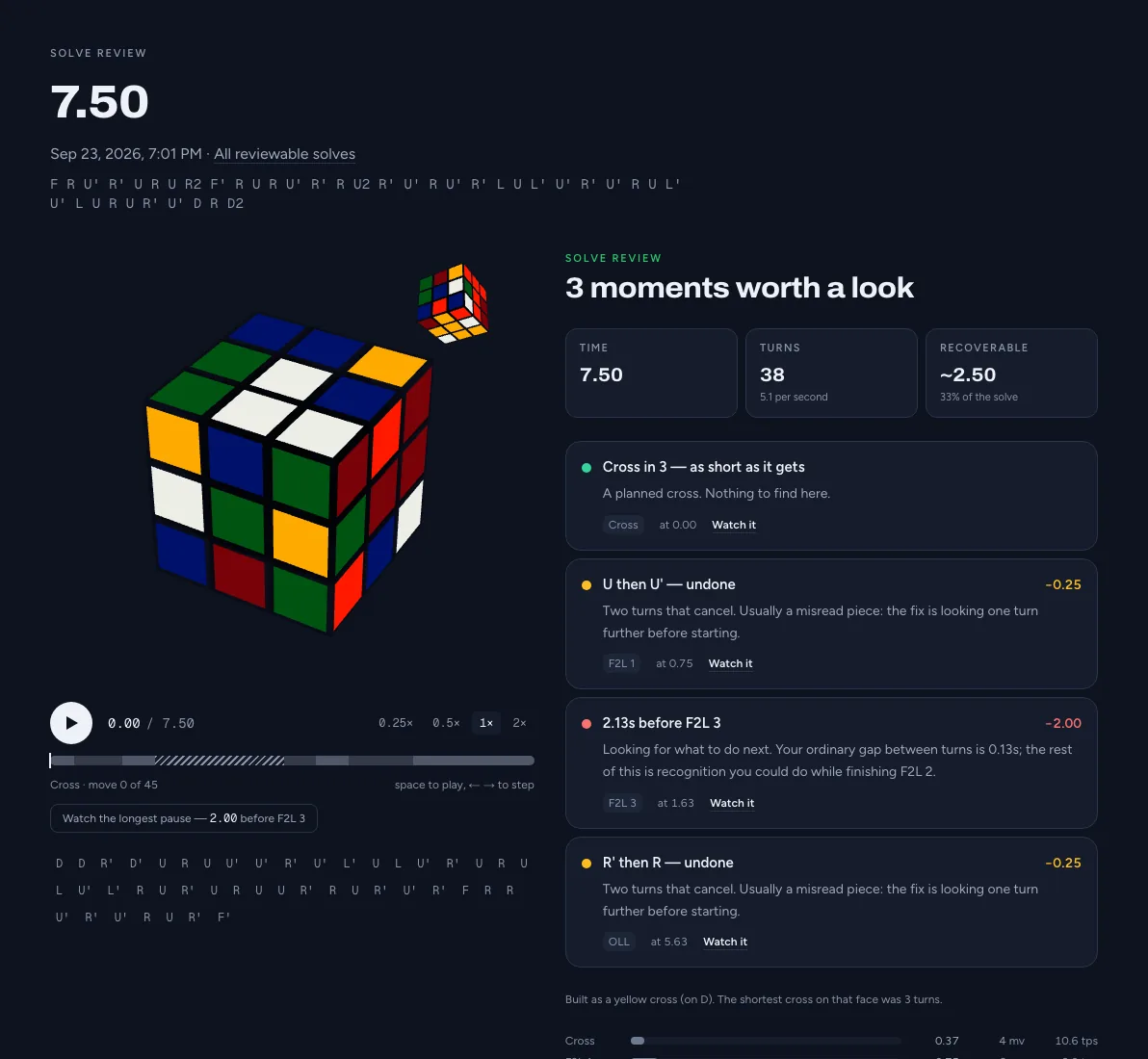
Insights
The habit costing you the most.
Across your last 25 solves, habits are ranked by how much time each one costs you — so you know what to practise tomorrow. It won't claim anything from fewer than five solves.
See your insights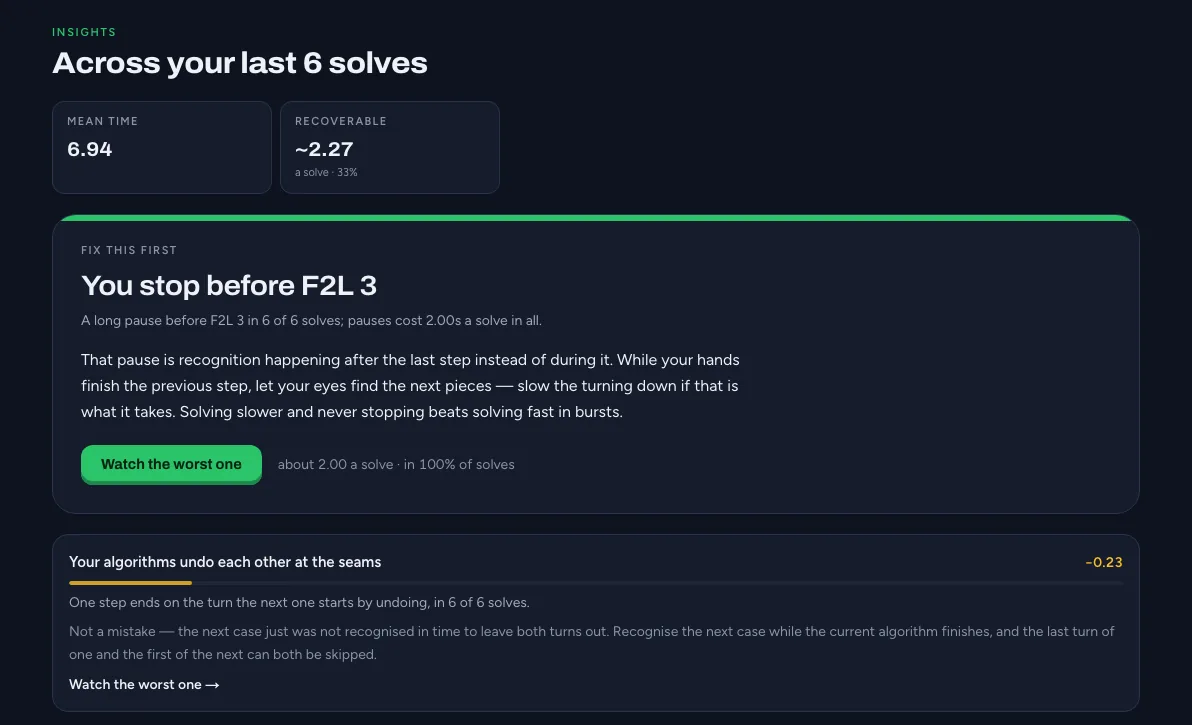
Race a friend, live
Send a link. A shared countdown, then the same scramble on both screens — and you watch each other get through the cross, the pairs and the last layer.
RaceA rating that means something
The server issues the scramble and replays your moves. If the cube doesn't end solved, the time doesn't exist. Your rating reads back as an average.
RankedOne scramble a day
The same cube for everyone, one attempt, and a streak for the days in a row you solve.
DailyEverything else
Whatever stage you’re at.
- Learn to solve Seven steps from never having solved one, each algorithm on a cube you can turn.
- Cube solver Stuck? Enter your cube's colours and get it solved in about 19 moves.
- All 78 algorithms Every OLL and PLL case, grouped by what you see on top, each checked against the puzzle.
- Drill your cases The cases you're slow on come back sooner, until each one is mastered.
- Rush Beat a target built from your own pace. It tightens every time you do. Three misses ends it.
- Clubs A board for your school or your friends, ranked by the same verified solves.
- Bring your csTimer history Import your export and your progress starts from where you are, not from zero.